
05.08.2026
Emotional pain in the body: understanding where it settles to be free of it at last
Journal · 2 July 2026
Emotional pain in the body: understanding where it settles to be free of it at last
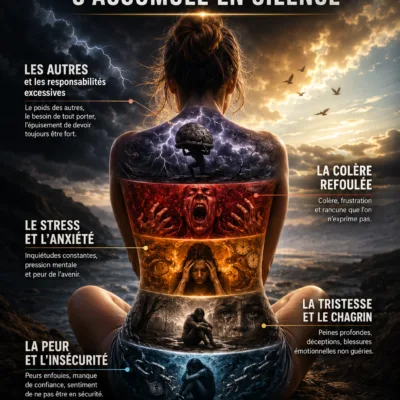
Do you sometimes feel your body speaks before you even find the words? A tension that stays in the shoulders, a knotted stomach before every heavy day, a deep tiredness that holds on despite rest… These signals matter. Emotional pain in the body is a documented reality, long overlooked. In Lausanne as elsewhere, more and more people want to understand what their body is trying to tell them, and how to listen to it at last.
Your body hurts and the reason stays out of reach?
The human body is far more than a biological machine. It is the silent keeper of everything you have lived, felt, held back. Every emotion left unprocessed, every tension stored up ends up written somewhere in your flesh, often below your awareness.
Sara, 38: when the shoulders carry what words leave unsaid
Sara comes for chronic pain in the shoulders and neck. Every physical cause has been ruled out. During a conversation on emotional ground, she realises that she carries the family logistics, her children’s anxieties and her employer’s expectations, alone. Delegating and saying no were never part of what she learned. For years, her body has been translating that invisible weight into real contractures. What Sara was living emotionally, her body was expressing physically, in silence, until it shouted.
Why unspoken emotions end up living in the body
When an emotion is felt but left unspoken, out of fear of judgement, out of the habit of keeping quiet, or because the setting made it impossible, the nervous system puts it on hold. The limbic brain triggers a survival response (fight, flight, freeze) that stays unfinished. That blocked energy is then stored as muscular tension, hormonal disruption or chronic pain.
This is what we call body memory: the body tells the truth, and it compensates.
The link between stress and the body is now recognised by neuroscience. Emotions have a physical address. And understanding where they settle is already the beginning of releasing them.
The five areas where emotional pain gathers most often
Shoulders, neck and upper back · the weight of others
This is the area of “carrying”. When you take on too much responsibility, when feeling supported or letting go stays hard, tension settles here. The relationship between stress and the body is particularly visible in this region: chronic contractures often speak of deep relational exhaustion, of an unmet need for a second pair of hands.
Jaw, liver and fists · swallowed anger
Swallowed anger is one of the most physically costly emotions. It shows up in jaw tension (night-time bruxism), pain on the right side, recurring migraines. Long held back to keep the peace or to look composed, it turns against the body itself: quietly, but surely.
Solar plexus and stomach · stress and anxiety
Physical anxiety has a precise address: the belly. The solar plexus is often called the “second brain”, and with reason. Constant worry, mental pressure, fear of what is ahead show up as digestive trouble, gastric spasms, that permanent “knot” that stays with you.
Throat, chest and heart · sadness and grief
Sadness left uncried settles in the chest and the throat. People who have been through bereavement, breakups or deep disappointments often feel a pressure in the chest, a lasting knot in the throat, difficulty breathing fully. The body tries to hold what was left unable to flow freely. Sadness and fear gather here, layer after layer.
Pelvis, lower back and legs · fear and insecurity
The pelvis is the seat of archaic safety. Fears buried since childhood, a fundamental lack of confidence, the feeling of having no right to exist fully or to be safe: all of it is stored in this deep area. Chronic low back pain, tension in the hips, heavy legs are often the direct reflection of it. This is physical anxiety in its oldest form.
An approach for releasing what the body holds
My approach rests on one central conviction: the point is to go through emotions fully, rather than to “manage” them.
Combining nervous system regulation, somatic work and body-and-mind support, you learn to identify the areas of tension, to understand what they carry, and to release them gradually, without forcing, without performing.
In Lausanne and across the canton of Vaud, this method supports people who are drained, anxious or simply disconnected from themselves, towards a lasting balance. Swallowed anger, sadness and fear left unsaid, chronic stress written into the muscles: all of it can loosen, on condition that it is given a space to speak.
A simple ritual to start a dialogue with your body
A simple start is enough to open this dialogue. Here are three practical steps to build into your day:
- The morning body scan (5 minutes) Lie down or sit comfortably. Close your eyes. Travel mentally through your body from head to toe. Note, without judging, the areas of tension, heaviness or discomfort. Ask yourself: “What am I carrying here?”
- The long exhale (2 minutes) Breathe in slowly through the nose over 4 counts. Breathe out through the mouth over 6 to 8 counts. Repeat six times. This technique activates the parasympathetic nervous system and helps the body release frozen tension. It is one of the most effective tools for stress in the body, available at any moment of the day.
- The evening emotion journal (5 minutes) Before sleeping, note one emotion you felt during the day: its name, the part of the body where you perceived it, and what it seemed to want to tell you. Unfiltered. Writing is a powerful tool for dislodging swallowed anger, physical anxiety and the sorrows we never dared show.
This ritual sits alongside professional support, and what it creates is an inner listening that changes your relationship with yourself for good.
What working on emotional pain in the body actually gives you
- Fewer unexplained chronic pains and a body that gradually finds its suppleness again.
- Stronger emotional regulation: fewer overflows, more clarity and more grounding.
- A sense of safety, back, even in the face of uncertainty and life transitions.
What your body tells you deserves to be heard
Emotional pain in the body is a message rather than a weakness. Every tension, every painful area is an invitation to look at what you carry, at what you were left unable to express, at what you need to feel better.
In Lausanne and across the canton of Vaud, learning to read this body language and to free yourself from it is possible, with the right support. If something is stuck in you, physically or emotionally, there may be a reason you are reading these lines today.
When you feel ready, book your conversation and start putting words, and movement, on what your body has been holding for too long.
is often right now.
The first step: a 15 minute call, free, no commitment.