
You have changed your mattress, tried the osteopath, given the Sunday evening yoga class a go. And still that tightness between your shoulder blades comes back, faithful as ever, every time the mental load grows heavier. The link between back pain and emotions has nothing esoteric about it: it is a reading of the body that Chinese medicine has practised for centuries, while Stoic philosophy was already learning to separate what belongs to us from what we carry for nothing.
What if the pain were not only mechanical?
We often look for a physical cause behind a pain that is, in truth, telling another story: a weight never set down, an anger swallowed, a fear never named to anyone. The back, in this, is an honest narrator. It does not lie, even when we would rather look away.
When the back speaks in place of words
Camille, 42, a manager in Lausanne, came to me with a pain between her shoulder blades that had not let go for six months. Three osteopathy appointments later, the tension always returned, like a faithful companion. Digging into it together, she realised that for a year she had been carrying an entire department at work on her own, without ever having said so out loud, not to her manager, not even to herself. Her body had forgotten none of it. Three weeks after finally putting words to that weight, the tension had begun to loosen, without any further manipulation having much to do with it.
Why this mechanism appears
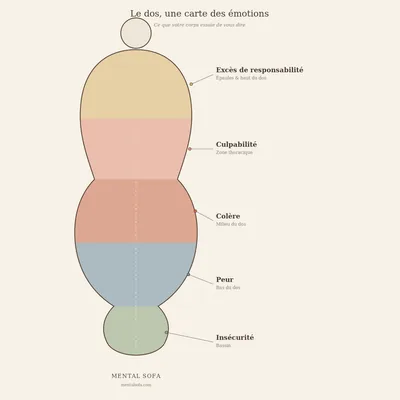
In traditional Chinese medicine, each major emotion finds an echo in a precise area of the back, along the spine.
The upper back and shoulders take the strain when you carry “the world on your shoulders”, an excess of responsibility linked to the Lung, which governs the breath. When you are overwhelmed, breathing becomes shallower, and tension settles precisely there.
The middle of the back, around the heart, knots with guilt and undigested regret. The Heart, in Chinese medicine, houses the Shen, the spirit; an imbalance there often shows up as tightness in the chest, anxiety, or broken nights.
Lower down, between the shoulder blades and the ribs, swallowed anger stalls the energy of the Liver, whose task is to keep the Qi circulating freely through the body. A frustration never voiced ends up lodging exactly there.
The lower back stiffens under fear and exhaustion, in connection with the Kidneys, which in this tradition govern vitality and our capacity to absorb stress. Chronic fear or a sense of insecurity often shows itself as lumbar weakness.
Finally, the pelvis closes when insecurity and a lack of grounding take over, an area Chinese medicine associates with the Lower Burner and the Belt Vessel.
On a more straightforwardly physiological level, an emotion left unexpressed keeps the nervous system on alert. The deep muscles of the back cannot tell the difference between real danger and mental load: they contract, and that is that. Which is exactly why you cannot lastingly manage chronic stress by treating the muscular symptom alone, without ever tracing back to what fed it.
What I find fascinating, and profoundly Stoic in its own way, is that this map of the back meets a question the Stoics were already asking two thousand years ago: does this weight depend on me, or not? Responsibility, guilt, anger, fear, insecurity, these are often burdens we keep carrying although they no longer belong to us, or never did.
The Mental Sofa approach
At Mental Sofa, I do not try to silence pain: I listen to it as information. My approach brings together Stoic clarity, accepting what is, telling apart what depends on us, with concrete work on bodily awareness. Nobody asks you to “stay positive” about emotional tension: you learn to translate it, then to decide, knowingly, what you go on carrying and what you can finally set down.
Let me be honest with you: I do not always have these tools to hand for myself. Even after years of practice, I still carry a weight long past the moment I should have put it down. Stoicism did not make me invulnerable, it simply taught me to notice a little sooner the instant my back sends the message before my head is willing to hear it.
Whether you are in Lausanne, elsewhere in the canton of Vaud, or by video call, discovering the Mental Sofa approach helps put meaning back between what the body endures and what the mind sometimes refuses to face. That is also the whole point of the work on bodily awareness I offer, built to last, not to soothe for three days.
A simple ritual to practise
- Place a hand on the tight area and breathe deeply, three times, without trying to release it straight away.
- Name, out loud or in writing, the emotion that might match that area: responsibility, guilt, anger, fear, insecurity.
- Ask yourself whether that weight really depends on you, or whether you carry it out of habit, or misplaced loyalty.
- Finish with a gentle opening movement for the back: a stretch, a walk, a few shoulder rolls.
Five minutes a day are enough to start defusing emotional tension before it settles in for good.
What you may notice
- A gradual easing of chronic tension, without forcing the body.
- A sharper ability to spot an emotion before it lodges itself in your back.
- Steadier sleep, where anxiety used to settle in the chest.
In short
Back pain and the emotions it carries are no accident: it is a map the body draws, patiently, to draw your attention where words have not been enough. Learning to read it is also learning to manage chronic stress rather than simply enduring it.
Curious to explore what your back is trying to tell you? Start with a call, 15 minutes, free, by phone.